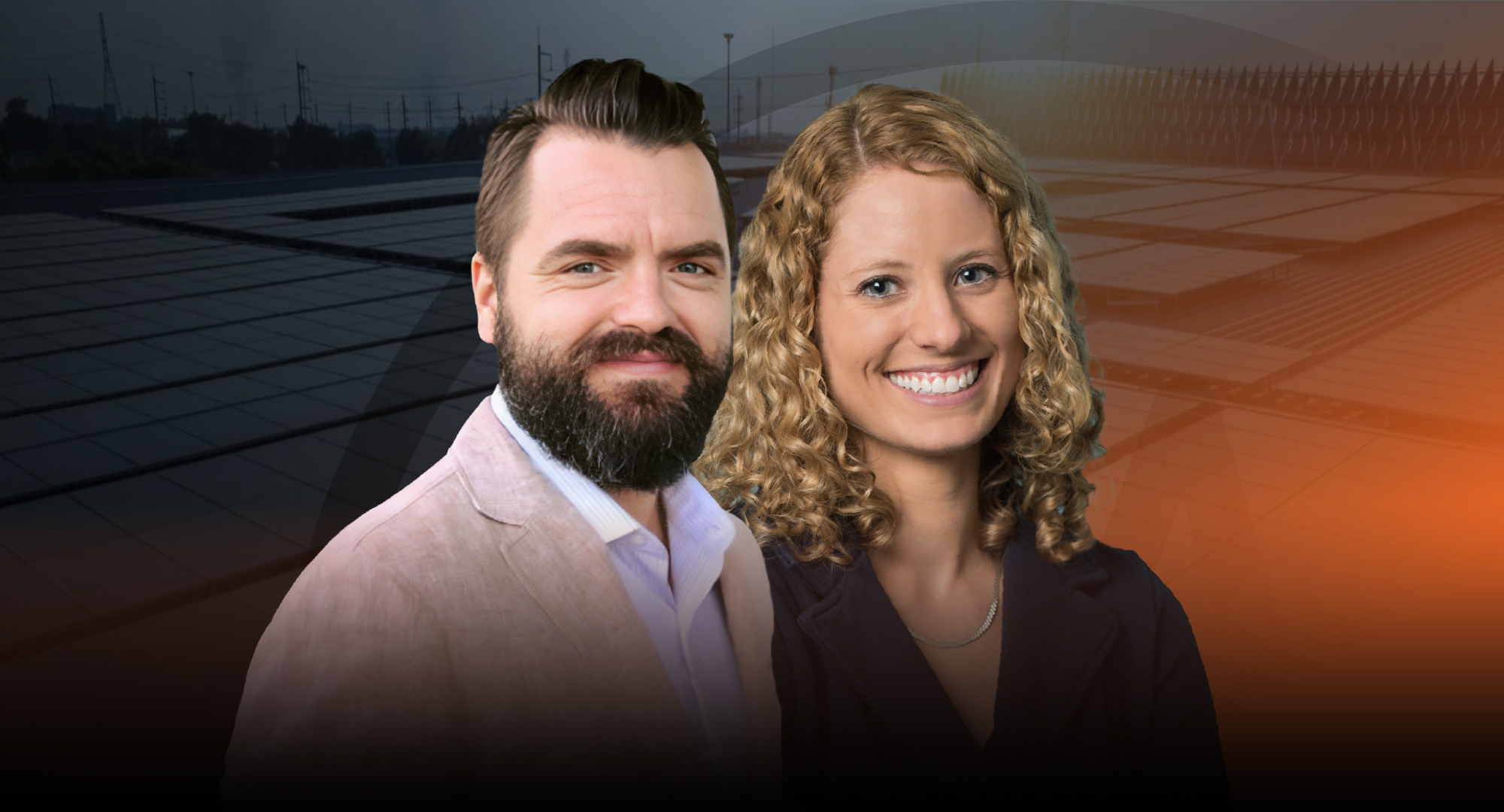

Colocating Data Centers to Solve Renewable Energy Curtailment
Real Estate/REITJohn Belizaire, CEO of Soluna, explains how their innovative approach of pairing data centers with renewable energy sites eliminates wasted energy while revolutionizing project economics.
Soluna is transforming the renewable energy sector by solving one of its biggest economic challenges: curtailment. In this episode of The Future of CRE Sustainability, John Belizaire, CEO, explains to Sean how their innovative approach of pairing data centers with renewable energy sites eliminates wasted energy while revolutionizing project economics. John shares how Soluna converts negative-priced curtailed energy into positive revenue streams, creating a symbiotic relationship between computing and renewable generation.
Originally inspired by a wind project in Morocco where the grid couldn’t accept the full power generated, Soluna discovered that up to 30-40% of clean power from solar and wind farms can be curtailed or wasted worldwide. Their solution brings flexible computing load directly to generation sites, enabling renewable projects to maintain production tax credits while improving financial returns for investors who previously saw diminished profits due to curtailment.
Topics discussed:
- How curtailment affects renewable project economics by forcing operators to pay to send power to the grid or shut down turbines, jeopardizing production tax credits and investor returns.
- Soluna’s behind-the-meter data center approach that transforms negative-priced curtailed energy into positive revenue streams, improving project IRR and enabling production tax credit capture.
- The flexible load model that enhances grid stability by functioning as energy storage without requiring batteries, creating a win-win for both power producers and grid operators.
- Strategies for navigating complex project finance structures when integrating data centers with existing renewable assets without disrupting established PPAs and tax equity arrangements.
- How computing demand’s shift toward power availability is creating a “grand awakening” in the energy sector, with data center developers now prioritizing renewable energy proximity over traditional site selection criteria.
- The mechanism of subtractive energy that enables seamless integration with existing power purchase agreements while ensuring grid settlements remain balanced.
- How co-located data centers with flexible load capabilities offer a more economical alternative to traditional grid-scale battery storage for managing renewable intermittency.
- The role of AI in optimizing energy planning, grid management, and infrastructure maintenance across renewable energy and commercial real estate portfolios.
Previous Episodes
Listen
Transcript
Note: This transcript was auto-generated and may contain minor errors.
Sean Swentek: Welcome to another episode of The Future of CRE Sustainability. I’m your host, Sean Swentek. Today, I’m speaking with John Belizaire, Chief Executive Officer at Soluna. John, thanks so much for joining me today.
John Belizaire: Nice to be here, Sean. Thanks for having me on the show.
Sean Swentek: I always check with my guests before that I’m pronouncing their name right, and I did not with you. I hope Belizaire was correct?
John Belizaire: You did a great job. That could’ve gone many ways, and I’ve heard it all sorts of ways. But yes, Belizaire. John Belizaire.
Sean Swentek: Excited to dive in with you today, John. So let’s jump right in. As someone who’s built multiple successful tech companies, what was the initial spark into your journey in renewable energy with Soluna?
John Belizaire: Well, I was introduced to the opportunity by a member of the board of one of the companies I was running. We had just sold the company. I was sitting by a pool starting to write a long series of cathartic articles about the experience being CEO of that company, and I got a call from this gentleman who’s head of a family office, private equity firm, and they were doing a bunch of renewable energy work in Morocco. He invited me to come look at this project that they had. They were having a challenge with a wind project, and it had all of these challenges on getting all of the power that would be produced there monetized.
I told him point blank, I don’t know anything about renewable energy. He mentioned blockchain at the time. I told him, I don’t know anything about that either. I don’t see how I can help you. I’m a software guy. Because we had a long standing relationship, he invited me to the office and said, “Look, why don’t you just come in, talk to my team, educate yourself?” I said I’m not doing anything. I’m supposed to go on this trip to the beach, and I’ll stop by.
I stopped by and started digging into the energy dynamic on the continent. This particular project was in the southern part of Morocco, and they were developing this very large wind project in what has to be one of the best wind regions in the world. Literally, if you go there, at the airport, there are only two types of people on the plane, maybe three. One is government because a lot of government people come down because it’s a big region. Two, it’s tourists. People who are coming there to hang out and enjoy the beaches. But all of the tourists are carrying this giant bag, which is a kite and a surfboard because it is literally the best kite surfing in the world because the wind is so strong there. It actually has a name. It’s called the Harmattan wind. And then the third category of passengers on the planes coming in and out of there are renewable energy people.
We were having difficulty developing the project because the grid wasn’t ready to accept the magnitude of power the wind farm would produce. In our research and trying to find ways to solve the problem, it occurred to us that computing would be the perfect solution. The question was, how do you find load for generation? How do you get that generation to load? We took a lateral approach and inverted the question and said, what if you could bring load to generation? How would you get load to generation? What kind of load could you bring down there?
That opened up a whole bunch of possibilities, and then it became clear that computing, which is a distributed resource, blockchain, or now Bitcoin mining, if you will, is a very compute intensive computing type of application. What if you can bring a data center that performed this type of computing to the plant? This could help solve our problem. Once we identified the solution, we realized that it was unlikely that we, in this amazing wind area, were the only ones that had this challenge.
In 2020, we started focusing our energy, no pun intended, on curtailment as a larger problem. It turned out in 2020 when everybody was stuck at home, us included, hard to go down to the windy beach area, we started focusing on curtailed energy, and it turns out it’s nearly a universal problem in clean energy development. Upwards of thirty to forty percent of clean power generated on solar and wind farms can be curtailed or wasted, which decreases the profitability of these power plants. So I’d say the journey, to answer your question, started in a very windy part of the world, and that wind is now at our backs, helping us to solve a pretty big problem in the space.
Sean Swentek: Can you talk about how Soluna is transforming the surplus renewable energy and revolutionizes the economics around these power plants?
John Belizaire: Absolutely. I’m very excited to talk about that. You remember how I said I know nothing about renewable energy to the investor that wanted me to come and do this crazy thing. It turns out we know a lot now. We know a lot about project finance and structuring projects and how all of that capital goes into these. Depending on your audience, these projects are multi hundred million dollar projects depending on the size. They could be even greater than that. We’re now seeing some of the largest power plants in the country and beyond come talk to us about putting our data centers at those locations.
When you look at those project companies, how are they financed? Well, the capital stack has equity, so sponsor equity. Maybe there was a developer they bought the asset from that may have some equity in there. There’s PTCs involved in these, so production tax credits, so there will be tax equity in there. There’s debt, and then there may be some cash equity players and other types of structures. All of those folks have different expectations on the return profile. Some of that equity capital may have come from very large pension funds that are expecting these projects to generate a certain amount of revenue over a long period of time and generate a low double digits to mid single digit sort of return.
What happens is the spreadsheet looks good. There’s some testing on potential curtailment. They build the project, energize it, and then what happens is all of a sudden, there’s a massive increase of curtailment that starts to build over a four to five year period. All of a sudden, these projects start to lose money because the grid signal at that location sends them a negative price signal, which says, “Hey, you can’t send your power. We don’t want you to send your power right now. And if you do, you gotta pay to send it.”
So they come out of pocket to send the power out because they have to send the power out in order to produce the tax credits, which they’re obligated to generate. They can only do that until the revenue that’s generated from the tax credits equals the cash that they would have to pay to send the power, and then they’re just off. The project goes down. You’ll start to see wind turbines being turned off.
So what we’re doing, I like to say, I drive up with my truck with the little circle delta Soluna logo on it and say, “Hey, I noticed half of your wind turbines are not spinning there.” And they’re saying, “Yeah, what about it?” I said, “Well, I can solve that for you.” And he says, “How? We’ve tried everything. Batteries. We’ve been trying to get the grid to expand the power lines for some time. Folks have explored green hydrogen, and that’s a very complex project.” There are just very few solutions to this problem.
We say, no, actually we have a perfect solution. We’re gonna build a data center. That data center will buy all of your excess unused energy. The power of that is that now when ERCOT says, for discussion purposes, “Hey, this wind farm is a hundred megawatts, tomorrow I only want you to send me fifty megawatts of that,” and I built a fifty megawatt data center back there, tomorrow when the wind farm is producing a hundred megawatts and would normally only be able to send fifty of that to the grid because the grid says you have to curtail, it’s maxed at that fifty. I build that data center now. It can produce a hundred megawatts and only still send fifty to the grid. So it’s still compliant, but it still made the other fifty megawatts and delivered that to us.
They got paid a positive price. We turned that negative price they would have paid to a fixed positive price and they get those PTCs. You can start to see the economic advantages that get created by the introduction of this facility because now all of a sudden, the project is making lots of gravy because we turn that excess energy that would otherwise have made no revenue and maybe even cost them cash to generating revenue and putting cash into the business. Those PTCs get generated. They used to be use it or lose it. Now they’re getting extended. But as you can see, what we’ve done is created a way to deliver economic value or advantage to those IPPs who can then look at this and say, “Hey, I now have a way to make revenue for power that otherwise would not have. I should build more of these things because I now have an embedded solution to the curtailment problem.”
That’s how we help these projects completely transform their economic footprint, and we believe ultimately drive the continued development and growth of these types of projects. That’s our mission as a company—to make renewable energy the dominant source of energy in the world. I think we’re already on our way to do that and the world is sort of heading in that direction. I like to say everybody’s in the back of an EV heading into the future. So that’s the way we do it.
Sean Swentek: From negative to positive, sounds like a no brainer for your average IPP.
John Belizaire: Hundred percent. Yeah.
Sean Swentek: What surprising challenges have you faced as you sort of merge your two worlds of computing and renewable energy? I know you’ve mentioned being a software guy in the past.
John Belizaire: One has been the learning curve. There’s a lot to learn in this type of business. You have to not only learn about renewable energy, the flow of electrons, like how do you create a data center back there, connect it to the renewable energy substation, and make sure the electrons flow to the data center. Like, how does that even work? I didn’t know that until I sort of understood more about electrons and physics and the concept of desire. We basically are putting a big toaster back there. The toaster’s on. The electrons go to where they wanted first. We’re the closest one. So it goes to us first before the grid.
You have to learn how to fit into these very complex project finance structures that have to work after you’re added to the project. You can’t break anything. By way of example, people ask this or they miss this all the time—let’s say the wind farm has a hundred megawatt PPA attached to it, and so they’re obligated to deliver that power downstream. We have a data center back there, and when the project is not curtailed, it has the ability to send a hundred megawatts. Well, we still need our fifty megawatts. So those electrons will still flow to us, and we’re essentially siphoning that energy. We call it subtractive energy.
What we do is we’ve developed this very simple, clever approach to solving the problem. The downstream off taker still has to get their hundred megawatts. What happens within a market driven environment like ERCOT, the electrons are flowing through the grid all the time. So if somebody’s drawing that hundred megawatts down the line, they’re gonna get a hundred megawatts of electrons. But after the trading period is closed and there’s settlement that has to happen, well, somebody owes ERCOT fifty megawatts worth of cash.
We solved that problem by essentially making the project whole for the rates that they would have gotten. We pay that price for that subtractive energy, and so they have the cash to deliver that to ERCOT, so now everybody’s happy. It took us a while to sort of think about how to solve that, what seems fairly simple the way I’ve described it, but it’s not easy to do that structurally. So those are challenges we have to go through that learning curve.
On the computing side, how do you build a data center that’s resilient to power loss in environments where power’s intermittent, and how do you build a financial business around delivering services to customers where the power is intermittent, and how do you deal with getting connectivity for these computers and building them in these remote locations and making all of that work, that whole stack of things that need to work. So there’s a lot of complexity to our business that we have worked through.
And then the last thing—all of those things are sort of, call it engineering and business architecture problems. The most surprising challenges to us have been, first, convincing the grid operator, for example, that our innovative solution was a good thing for the grid. The assumption is that if you have load behind the meter, it’s breaking the sort of structural and financial incentives to support the build out of the grid, and you’re using resources and all that kind of stuff. We go through those debates a lot.
But the way we position it is, well, the grid is adding more and more flexible generation resources. For the grid to deliver robust power using these resources, it needs another piece of technology, which is essentially energy storage capability or energy buffering, if you will. That’s like nearly impossible to build out unless you use this lateral approach. See, by bringing load that’s not sort of fixed load, but flexible load, you actually retroactively deliver to the grid a value that would have cost them billions of dollars to build out. But I make all the CapEx investment, and I ultimately deliver a resource to the grid, which is a demand response flexible resource that creates that buffering for them. Otherwise they would have to contract out for batteries and all sorts of other resources, which they do, or dispatchable generation, which they do. But this allows them to increase the capabilities of the grid to be more resilient to this ever changing power dynamic that’s happening.
We think that’s going to accelerate now with the emergence of AI and how that’s gonna change everything. So it’s been surprising, I guess, that grid operators don’t see the both economic and technical advantage that comes from this new type of innovation. That’s changing slowly but surely, but that was something we had to deal with. So it took a lot of education, a lot of collaborative discussions around this, and we’ve sort of found our way through.
And then the last thing is people. I’ve been an entrepreneur now for approaching twenty five years, maybe more because COVID kinda warps things to me. It never ceases to surprise me how much you have to take into account people and human behavior in the innovation business. People are generally resistant to taking new risk and investing in new technology or partnering with companies or doing something new. Going to these projects that have all sorts of different constituencies that are involved in the project—I mentioned them earlier, the equity, tax equity, debt, all that kind of stuff—nobody wants to create any kind of new risk in a project like that. Getting all of them to sort of come to the table and agree on how to bless this and what they need to know and all that kind of stuff proves to be very challenging.
That’s why I tell people it’s not easy to do what we do at Soluna. It looks easy after it’s all built and running and humming, but you don’t understand. Developing these projects are very challenging. A lot of it has to do with good old fashioned relationship building, education, and preemptively addressing the most likely concerns and objections to a solution like this.
Sean Swentek: Well said. How are you seeing property developers react to the opportunity of on-site computing powered by renewable energy?
John Belizaire: You mean traditional real estate property development?
Sean Swentek: Just data centers, anyone who’s developing properties. What is the appetite like for or even the understanding of the opportunity around using renewable energy to power those sites?
John Belizaire: Good question. I think that there is a grand awakening. I’ll describe it as that. There’s a grand awakening underway across the energy market, the data center market, the customer market who traditionally are looking for data center solutions. For many years, the data center business has been a pretty not so sexy business. Nobody was talking about data centers. I mean, people knew they’re out there. We hold our phones. We use applications and so forth. But nobody really sort of gives a thought to where those data centers are located.
But if you were to draw a map, what you would find is that they’re pretty concentrated in their location. Virginia probably has the largest concentration of data centers on the planet. They tend to be closer to population centers, closer to big Internet hubs, closer to places where you have expertise and so forth. So there is an entire industry—I was gonna say cottage, but it’s not exactly a cottage industry. It’s about billions of dollars. But it’s definitely a whole industry that is architected around building data centers in a very specific way, very specific location, and there’s a whole stack from the land developer all the way up to the full vertical data center operators.
There’s a new industry, I call that a cottage industry, where people are beginning to go further afield beyond those places and start to rethink where data centers can be built. They’re in more rural areas of the country. They are now more and more close to or will be co-located with wind and solar farms because the primary search algorithm, if you will, is power now. It’s not so much land, proximity to the user. It’s like, we need gigawatts of power for this stuff, and we need it now. And that’s changing. As I said, it’s changing the entire industry.
You are now seeing some of the largest funds in the world, and we saw this in the renewable energy space, actually, Sean. You saw during COVID when there was this grand awakening much like this that, “Hey, wow, this fossil stuff really sucks. Like, we should get rid of that stuff. We need to be more self sufficient from an energy perspective, and we need to be more sustainable, and let’s go big on this.” And all of a sudden, there was this grand awakening, and you had so much capital come into the renewable energy space. That’s why you have all these curtailment problems. You have a large concentration of projects that are located in the same area trying to get all of their power onto the same limited grid space that it completely transformed the renewable energy space.
Renewable energy is now the cheapest form of energy. We can argue about it out there, folks who are still pro fossil fuels, but renewable energy cost is going down. You can build much bigger, scalable facilities, and they’re being built all around the world now. And you’re now seeing a similar thing. Like, I mean, you had funds going and buying these development companies, these big renewable energy developers, big IPPs became bigger, and big pension funds actually started to vertically integrate. They’re like, “You know, you developers and everything, you guys are telling us you can deliver these products. You know what? We can do this ourselves. Like, why would we give you the fees?” They just went and bought platforms. Renewable energy platform—it was just amazing to me. Like, I went to the wind and solar conference maybe three years ago. I was amazed. Still learning from the fire hose.
Same thing is happening now in the data center space. You are now looking at that. It’s a project, just like anything else. You have to develop it. You have to find the land sites. You gotta find good connectivity. And everybody’s trying to, first, build the biggest platform possible, and second, develop something that is unique, something that’s gonna differentiate them to attract capital. The key differentiator right now is how can you find a way to get access to proprietary assets and sites that you can develop large facilities on? You’re talking about sites that can start in the hundreds but get to the gigawatts very fast. And then second, how can you do it faster than anybody else? And that means leapfrogging the interconnection queues that are just getting longer every day.
The solution is to go co-located. Go behind the meter and build the data center at the location of these power plants. But this is important for all the folks who are in the grid operators out there, utilities—don’t do it in a way that decreases the reliability of the grid. So showing up to a nuclear plant or a big gas plant and saying, “Hey, we wanna buy all of your power, period. It is no longer going to the grid. We’re taking it offline. So we’re going off grid. We’re like a four, five hundred megawatt facility.” At Soluna, we like to say, no bueno. That’s no bueno.
But if you do like what Soluna does, where we’re essentially integrating to a resource that is still available to the grid, we’re adding a data center that has flexibility capabilities so we can return power to the grid when needed, you now have enhanced the grid and accelerated your ability to build the next generation facility for the future of computing. That’s what’s changing in the space. It’s basically seeing a whole new stack being built.
Sean Swentek: That’s exciting times. How are you seeing AI and other things, machine learning, change energy management for commercial buildings, data centers? What are you seeing in that space?
John Belizaire: AI is changing everything. I was in DC earlier this year at a conference put on by Latitude Media. It’s called Transition AI. I was on a panel that was talking about what we just talked about, sort of like what’s the new way of building data centers that people never heard of.
But there was a series of panels that were talking about how AI is changing the way we pretty much do everything in energy. There’s AI now involved in the planning process. Planning is like the place that is most ripe for the application of AI. What’s the optimization problem? It’s like, where is our demand coming from? Well, data centers, obviously, these days. But seriously, like, where is our demand coming from? And what’s the best stack of our generation resource mixture to deliver on that? And then once that’s been met, what’s the best way to continue to forecast that? And AI, it turns out, is better than us at doing that. Solving those types of problems is perfect for AI.
Looking at the grid infrastructure itself and finding places where maintenance needs to be enhanced, upgrades need to be made, and highlighting those areas based on data about the usage and future usage of that infrastructure. Everything from power line management, tree pruning, to upgrading the bandwidth of these lines to deliver more power to a particular location. That’s all now being tested in a number of the different energy markets because you’d have to be out of your mind not to be using this technology at this point.
But you would be surprised that there is some concern about its efficacy and how well it can do things the way they’ve been done before through more long, drawn out, arduous processes around planning. And what they’re finding through some of these POCs is it’s not only matching but exceeding their expectations on the use of that technology.
I think AI, just taking a step back from energy, is going to be one of the greatest technologies that we’ve come up with as a species. And I think if you’re listening to this and you’re not using it, learning about it as much as possible, you’re lost. I mean, I hate to say it, but we finally have reached the level of this technology where it truly has the ability to accelerate just about everything that we do. You’re gonna be left behind. No question.
Sean Swentek: John, I’d love to move to some lightning round questions. I’m asking all my guests these five questions. I wanna get people’s immediate quick response. So one sentence, two or three sentences max. I’m excited to hear your thoughts on these. Number one, solar, wind, or other—what’s your bet for the dominant renewable energy source in the commercial real estate data center sector by 2030?
John Belizaire: I’d have to say solar because it’s just so much easier to build. There’s more investment being made. And now within our current regulatory and the current administration, I think solar would be a good bet to invest in. Its cost has come down a lot, and it’s being built just all around the country. The beauty of it, you can mix solar and batteries and actually build some really exciting microgrid solutions. So I think you’re gonna see a lot more solar get built.
Sean Swentek: I’d love to hear that. What’s one prop tech, property technology solution that you’ve seen or used that’s exceeded your expectations in what it delivers?
John Belizaire: We don’t do a lot of that, but in my sort of entrepreneurial days, I’ve seen these really advanced sort of property management and sort of field management solutions that are really helpful. That’s what I would say. I think you’re gonna see a lot more of that too. Sort of AI driven optimization solutions for property management platforms are gonna be really, really exciting to see come out. Building management and service management solutions. Managing contractors, managing the design of different facilities, thermodynamics, sustainability aspects, where do you source power? Should we use the solar panels on the roof today or should we burn some oil? That sort of thing.
Sean Swentek: When you wake up in the morning, what’s the first site metric, sustainability metric on one of your sites that you’re checking to make sure things are the way they’re supposed to be?
John Belizaire: The number one thing that’s on our dashboards is availability. How much is the site up? And that has a lot to do with sustainability. So if it’s really windy today, we’re gonna see some interesting dynamics in the data center. If it’s not, but it’s really hot out, we’re gonna see some interesting dynamics on the data center because prices will spike. So we look at availability, which is sort of like a Soluna term that encompasses a lot of different data points that give you a sense of the current and potential uptime for our data centers.
Sean Swentek: Love it. Complete this sentence. The biggest myth about green facilities is?
John Belizaire: The biggest myth about green facilities is that they’re not the same in terms of uptime, reliability, scalability as traditional tier three or four facilities. That is absolutely not true just because you’re using green electrons. And in fact, just because you’re behind the meter or co-located with a green site does not mean that the robustness of the data center solution has decreased. It actually is equivalent, if not better, because now you can get the same level of reliability and uptime at a much lower carbon footprint and equal scalability, and even because of our particular design, much better pricing. When you combine those two things, it’s like you gotta be out of your mind for not investing in more green stuff. So I don’t wanna say people listening to this are out of their mind, but I think you need to change your mind. That’s for sure.
Sean Swentek: Alright. Final question here. If you had ten million or a hundred million, whatever it would take to invest in one sustainability upgrade for your property right now, any property, what would it be?
John Belizaire: I would definitely invest in microgrids. The typical data centers use gas fired turbines or your traditional diesel as the resiliency solution, if you will. At our facilities going forward, we wanna build resiliency solutions that are also sustainable. So that might be the combination of solar battery and other types of really cool technology coming out right now around sustainability. Microgrids, which were sort of these cute little things that we would build in parking lots and stuff like that is actually becoming an industrial enterprise class solution. Here in New York, JFK, they’re building like a huge backup system that is a mix of different technologies. Good friend of mine is the CEO of the company doing that, and it’s very exciting to see that. And you’re gonna see a lot of that with the rise in data centers too.
Sean Swentek: That’s such a cool project. I was reading about that recently. John, we could talk about this forever. This is a topic that a lot of our listeners are keen to learn more about. I had a bunch more questions we didn’t have time for today. Maybe I can send them to you. You can get back to me, and I can upload your answers to the listing on the site if you’re amenable to that.
John Belizaire: Yeah.
Sean Swentek: In the meantime, if people wanna learn more about Soluna and your work and what you’re doing, where’s the best place for them to go?
John Belizaire: We’re everywhere. I would start with solunacomputing.com. That’s our website. You can learn about what we do, our services. If you’re an IPP, you can learn about our curtailment assessment. That’s where we help you understand what a data center would do for your projects. We are on LinkedIn. Just search for the Soluna company page on LinkedIn. You can search for me. I’m pretty active as well. We’re on X. You can get the latest news on the company and what’s happening with us on that platform as well. And on our website, there’s a whole series of resources like video. You can go to YouTube, which kinda takes you through actual documentary style videos about our sites and our story. So I would hit those locations to learn more about Soluna.
Sean Swentek: John, thank you so much for your time today. I really appreciate it. To all my listeners, thank you for joining us on another episode of The Future of CRE Sustainability. I’ll see you next time.
What's next
Communicating Sustainability's Value to CRE Investors
Unlock Data Insights 43 min
Emily Pierce, VP of Impact at Acento Real Estate Partners, offers practical wisdom on implementing sustainability practices in multi-family housing.
Watch